
Sign up for "Implementing a Kill Switch for AI" on Sep 22nd
Join the Unleash team to learn how to integrate runtime control in your AI strategy.
Do I need continuous delivery, or continuous deployment?

Alex Casalboni
Developer Advocate
January 28, 2026
The terminology surrounding “CD” often creates more confusion than clarity. While continuous delivery and continuous deployment share a lineage and a set of technical foundations, they represent fundamentally different approaches to risk, governance, and the definition of “done.” One leaves the final push to production in human hands; the other automates it entirely. Choosing between them isn’t just about how fast you want to go. It is about how your organization handles control.
TL;DR
- Continuous delivery ensures your code is always in a releasable state, but requires a manual trigger to update production.
- Continuous deployment automates the entire pipeline, pushing every change that passes tests directly to end users without human intervention.
- High-performing teams often aim for continuous deployment but revert to continuous delivery due to regulatory requirements or a lack of test maturity.
- Decoupling deployment from release using feature flags allows you to practice continuous deployment safely by keeping new code dormant in production until you are ready to reveal it.
The Core Difference: Automation vs. Approval
The distinction between these two practices usually comes down to a single button. In both scenarios, the pipeline from code commit to staging is automated. The divergence happens at the final mile.
Continuous delivery (CDel)
In a continuous delivery model, your build pipeline runs automated tests, creates build artifacts, and deploys them to a staging or pre-production environment. The code is theoretically ready for production at any moment. This is the “delivery” aspect. However, the actual move to production remains a manual business decision.
You might choose this path if your industry requires audit trails for every release, or if your product team prefers to bundle features for a specific marketing launch date. The engineering team guarantees the software can go live, but the business decides when it does.
Continuous deployment (CDep)
Continuous deployment removes the manual gate. If the code passes the automated test suite, it goes to production immediately. There is no “release day” because releases happen multiple times a day, or even multiple times an hour.
This approach requires an extremely high level of confidence in your testing infrastructure. If your test coverage has gaps, continuous deployment will efficiently ship bugs to your users. However, for teams that master it, the feedback loop is immediate. According to Google Cloud’s research, elite performers who adopt these practices achieve 973 times more frequent code deployments than low performers.
The Trade-off: Velocity vs. Governance
The choice between delivery and deployment forces you to evaluate your organization’s tolerance for risk and its operational maturity.
The case for continuous delivery
Continuous delivery is the safer starting point for most organizations. It enforces discipline: developers must keep the trunk clean and releasable, without forcing the organization to adopt a “fail fast” mentality in production immediately.
This model suits machine learning workloads or heavily regulated industries like finance and healthcare. In these sectors, a human signature is often legally required before state changes occur. Continuous delivery allows you to automate 99% of the process while preserving that 1% control layer for compliance.
The case for continuous deployment
Continuous deployment is the target state for teams prioritizing mean time to recovery (MTTR) and rapid iteration. When you deploy continuously, your batch sizes (the amount of code in each release) are inherently small.
Small batches are easier to debug. If the system breaks immediately after a deployment, the culprit is almost certainly the five lines of code that just landed, not the 5,000 lines merged over the last two weeks. This leads to higher stability over time, provided your monitoring is robust enough to detect issues instantly.
The Missing Link: Decoupling Deployment From Release
A false dichotomy often clouds this conversation. Teams believe they must choose between the safety of continuous delivery and the speed of continuous deployment. In reality, modern engineering teams separate the technical act of deployment from the business act of releasing.
Deployment is moving code to a server. Release is exposing that code to a user.
By using feature flags, you can adopt continuous deployment for your backend processes while maintaining the control of continuous delivery for your user experience. You ship the code to production automatically (Deployment), but wrap the new functionality in a flag that defaults to “off” (Release control).
This progressive delivery model gives you the best of both worlds. Your engineers stop managing merge conflicts and long-lived feature branches, and your product managers retain control over when features go live to the customer base.
Managing the risk of automation
If you automate deployment without decoupling the release, every deployment is a potential incident. Once you introduce feature management, a deployment becomes a low-stakes event.
If a newly released feature causes errors, you do not need to roll back the entire deployment (which might contain fixes and updates from other teams). You simply toggle the flag off. This capability is distinct from a kill switch, although the mechanics are similar. It changes the operational posture from “hoping tests caught everything” to “verifying in production with a safety net.”
Decision Framework: Which Path Fits Your Team?
Moving to continuous deployment is not just a tooling change; it is a cultural shift. Use this checklist to determine if your team is ready to remove the manual approval gate.
1. Test maturity
Do you trust your test suite implicitly? If a test fails, does it stop the line every time? If your team frequently overrides test failures or says “that test is just flaky, ignore it,” you are not ready for continuous deployment. You need a reliable signal-to-noise ratio in your CI pipeline before you can automate the push to production.
2. Observability
Can you detect a problem in production before your users call support? Continuous deployment requires real-time monitoring. You need to know within seconds if error rates spike or latency increases after a deployment. Without this visibility, automating deployments is essentially flying blind.
3. Architecture
Is your application monolithic or decoupled? Monoliths make continuous deployment difficult because every small change requires redeploying the entire stack. Microservices or modular architectures support continuous deployment better because you can deploy independent services without risking the entire platform.
4. Cultural readiness
How does your organization handle failure? Blameless post-mortems and a focus on inquiry rather than punishment are prerequisites for continuous deployment. If an engineer breaks production via an automated pipe and gets punished, the team will revert to manual gatekeeping out of fear.
Implementing Progressive Delivery
If you decide to move toward continuous deployment, the safest path is via progressive delivery workflows. This involves using strategies like canary releases or ring deployments to limit the blast radius of new code.
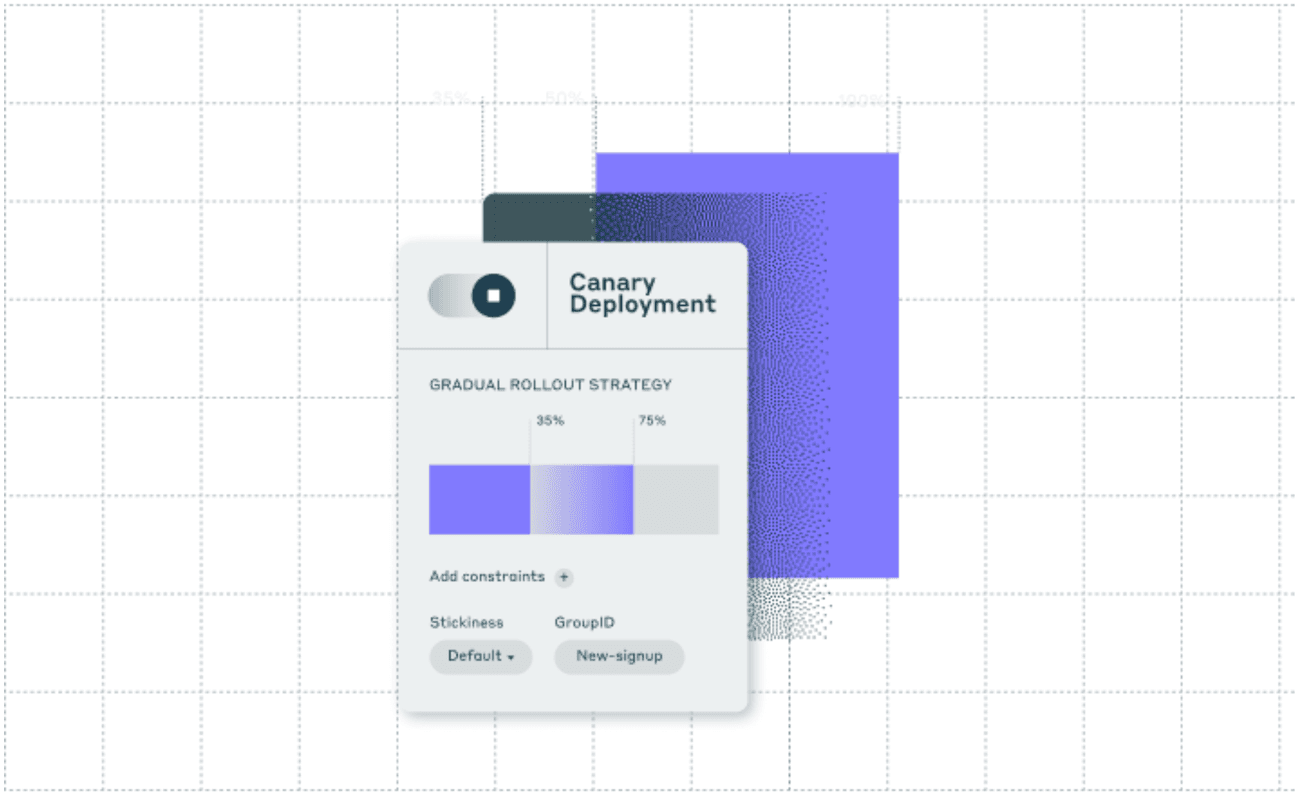
In a canary release, you expose the new version to a small subset of infrastructure or users. If metrics remain stable, the rollout continues. If errors rise, the system automatically reverts.
Tools like Unleash support this by allowing you to define activation strategies for your features. You might enable a feature only for users with an @internal.company email address, or for 1% of your traffic. This logic resides in the application code, evaluated locally by the SDK, ensuring that even if the management service is unreachable, your application defaults to a known safe state.
Handling flag debt
A common pitfall when using flags to facilitate continuous deployment is the accumulation of technical debt. Once a feature is fully released and stable, the flag protecting it becomes obsolete.
You must treat feature flags as temporary artifacts. Define an expected lifetime for your release flags, typically a few weeks. If flags remain in the codebase indefinitely, they increase complexity and make testing the system’s actual behavior difficult. Establish a cleanup process where removing the flag is the final step in the definition of done.
Conclusion
The question “Do I need continuous delivery or continuous deployment?” often leads to the wrong answer because it presents a binary choice between safety and speed. You need the discipline of continuous delivery, keeping your software deployable at all times. Whether you choose to automate the final step (deployment) depends on your ability to mitigate risk.
For most teams, the winning strategy is to automate the deployment pipeline fully while managing release risk through feature flags and progressive rollout strategies. This allows you to deploy code hundreds of times a day without terrifying your stakeholders. Start by solidifying your automated testing, decoupling your release process, and then slowly removing the manual gates as your confidence grows.
FAQs about continuous delivery vs continuous deployment
What is the main difference between continuous delivery and continuous deployment?
Continuous delivery requires a human approval step to push code to production, while continuous deployment automates this step so that every passing build goes live immediately. Continuous delivery ensures code is always ready to deploy, whereas continuous deployment ensures code is always deployed.
Is continuous deployment safer than continuous delivery?
Continuous deployment can be safer in mature organizations because it encourages small, frequent updates that are easier to debug than large, infrequent releases. However, without robust automated testing and observability, continuous deployment introduces significant risk of shipping bugs to users automatically.
Can I do continuous deployment with a monolithic application?
You can practice continuous deployment with a monolith, but it is technically more difficult due to longer build times and the risk of side effects across the entire application. Teams often find it easier to implement continuous deployment strategies when working with decoupled services where independent components can ship without coordinating the entire system.
How do feature flags enable continuous deployment?
Feature flags allow you to deploy code to production while keeping the new functionality hidden from users. This mitigates the risk of continuous deployment because even if the code goes live automatically, the “release” is still controlled and can be turned off instantly if issues arise.
Do I need to master continuous integration before continuous delivery?
Yes, continuous integration (CI) is the foundation for both delivery and deployment practices. You cannot reliably keep software in a deployable state or automate deployments if you do not first have a process where developers frequently merge code and run automated tests to resolve conflicts.
Share this article