
Webinar - Melinda Fekete
Implementing a Kill Switch for AI - August 27th
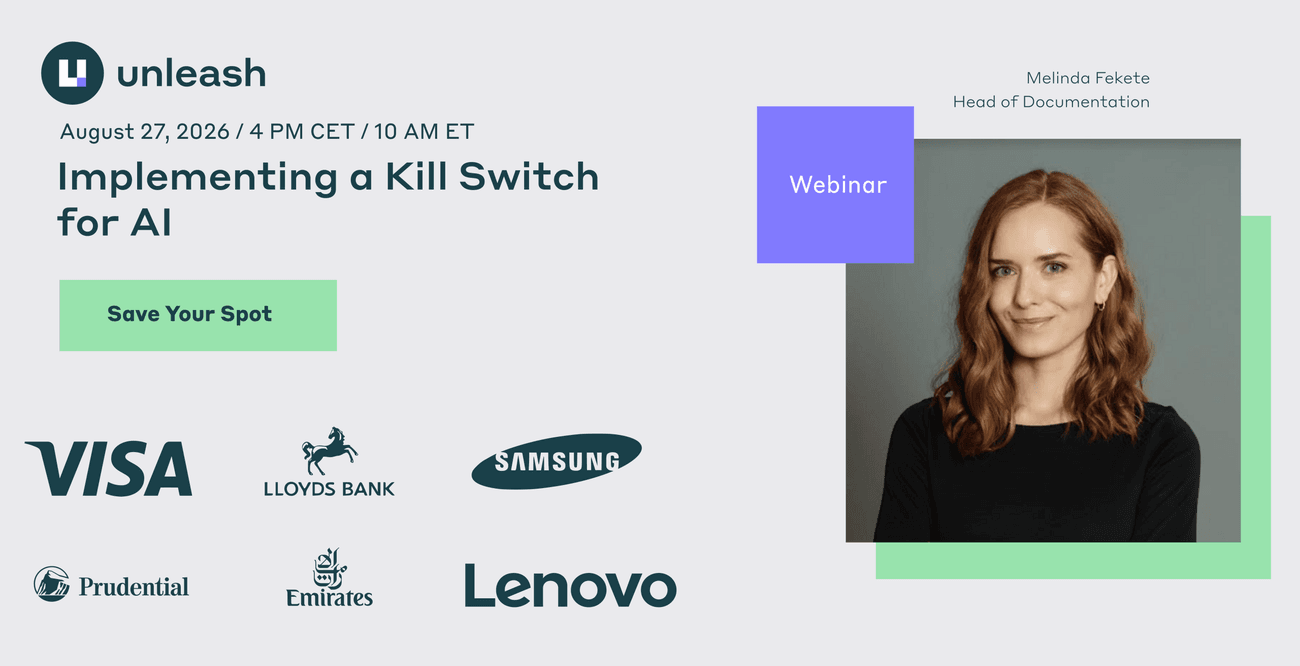
A Kill Switch for AI
Code is being written faster than ever, especially with AI. But speed without control is a false economy. In 2025 alone, Google Cloud and Cloudflare, two of the most mature engineering organizations in the world, suffered major outages from changes that reached their entire infrastructure at once, with no gradual rollout to contain the blast radius. Google's own postmortem committed to a fix: put changes behind feature flags, off by default.
The time to plan for runtime control is now, before your next incident.
In this live session, we build up runtime control from its simplest form to fully automated protection, all on a real running application:
The Kill switch
Turn a live feature off in seconds, no redeploy, no pipeline, and see why separating deploy from release changes how safely you can ship.
Targeting and gradual rollouts
Release a feature to one user, then a percentage, then everyone, and control exactly who sees what at runtime.
AI-assisted development, with control built in
Watch an AI coding assistant build a feature and wrap it in a feature flag on its own, through the Unleash MCP server, so the assistant that writes risky code also makes it reversible.
Automated safeguards
A progressive rollout monitored by a live user metric that pauses itself when the signal turns bad, with nobody at the keyboard.
You can take part in this one from your own browser. Everything shown runs on an open source repo you can take home and reproduce on a free Unleash trial.
Whether you have never touched a feature flag or you run thousands of them, you will leave knowing how to keep AI-speed shipping reversible.
Code is being written faster than ever, especially with AI. But speed without control is a false economy. In 2025 alone, Google Cloud and Cloudflare, two of the most mature engineering organizations in the world, suffered major outages from changes that reached their entire infrastructure at once, with no gradual rollout to contain the blast radius. Google's own postmortem committed to a fix: put changes behind feature flags, off by default.
The time to plan for runtime control is now, before your next incident.
In this live session, we build up runtime control from its simplest form to fully automated protection, all on a real running application:
The Kill switch
Turn a live feature off in seconds, no redeploy, no pipeline, and see why separating deploy from release changes how safely you can ship.
Targeting and gradual rollouts
Release a feature to one user, then a percentage, then everyone, and control exactly who sees what at runtime.
AI-assisted development, with control built in
Watch an AI coding assistant build a feature and wrap it in a feature flag on its own, through the Unleash MCP server, so the assistant that writes risky code also makes it reversible.
Automated safeguards
A progressive rollout monitored by a live user metric that pauses itself when the signal turns bad, with nobody at the keyboard.
You can take part in this one from your own browser. Everything shown runs on an open source repo you can take home and reproduce on a free Unleash trial.
Whether you have never touched a feature flag or you run thousands of them, you will leave knowing how to keep AI-speed shipping reversible.

Speakers
Meet the Speaker
Melinda is the Documentation Lead at Unleash, where she works at the intersection of product, engineering, and developer experience.
She started her career as a software developer and has worked and lived across Europe.
With experience spanning large enterprises and fast-growing startups, she focuses on turning complex systems into clear, practical knowledge that helps teams ship with confidence.
She started her career as a software developer and has worked and lived across Europe.
With experience spanning large enterprises and fast-growing startups, she focuses on turning complex systems into clear, practical knowledge that helps teams ship with confidence.

Melinda Fekete
Head of Documentation, Unleash